Class Peacock (Years 3 and 4)
Welcome to Class Peacock!
Class Peacock is named after Paralympic champion Jonnie Peacock, whose determination, resilience and commitment to achieving his goals provide an inspiring example for our pupils. In our class, we encourage children to show these same qualities by working hard, supporting one another and persevering when learning becomes challenging. We celebrate curiosity, creativity and independence, and believe that every child can achieve when they are given the right support and opportunities to succeed.
Our learning journey is full of exciting experiences, discoveries and opportunities to develop new skills. Please visit our page regularly to see what we have been learning and celebrating together.
Staff
Class Teacher: Mrs Graham & Miss Smith (Thursday pm and Friday)
Teaching Assistant: Mrs Begum and Miss Nikki
| Class Routines | |||||||||||||||||||||||||||||||||||||||||||
|---|---|---|---|---|---|---|---|---|---|---|---|---|---|---|---|---|---|---|---|---|---|---|---|---|---|---|---|---|---|---|---|---|---|---|---|---|---|---|---|---|---|---|---|
Class RoutinesReading books: Brought in daily, changed weekly. (See your change-over day in your reading record) Homework: Set and returned on a Wednesday Spellings: Set on Tuesday – tested the following Monday PE: Thursdays and Fridays Swimming (wear PE kit): Thursday (Spring Term) Celebration Assembly: Friday |
Checked daily | ||||||||||||||||||||||||||||||||||||||||||
Homework
Homework in Class Peacock is designed to be manageable, meaningful and closely linked to the learning taking place in school. We believe that regular, short activities help children build confidence, fluency and independence.
Each week, children will have:
- Spellings: Weekly spellings to learn and practise at home.
- Times Tables: Regular practice using Times Tables Rock Stars (TTRS) to develop multiplication fluency.
- Reading: Children should read every day at home and record their reading in their reading record.
- Maths or English: One additional piece of homework each week, alternating between Maths and English. These activities will be linked directly to the learning taking place in school, giving children an opportunity to practise and consolidate what they have been learning.
We encourage families to make homework part of a regular routine, with little and often being the most effective approach. Reading regularly and practising times tables in particular will help children develop the fluency and confidence they need as they progress through Key Stage 2.
Curriculum Coverage
This Term's Topic – Erupting Empires

Our Autumn Term topic is Erupting Empires, where children will explore the fascinating world of the Romans alongside the dramatic physical geography of volcanoes. Through a combination of history, geography, science, art, design and technology and English, pupils will make connections between their learning and develop a deeper understanding of the world around them.
Our key texts for the term are We Are the Romans by David Long and Escape from Pompeii by Christina Balit. Autumn - Erupting Empires
Mathematics
During the Autumn Term, pupils will develop their understanding of number, calculation, multiplication and fractions. They will begin by developing their ability to add and subtract across 10 before working with numbers up to 1,000 and 10,000. Children will develop their understanding of column addition and subtraction, applying these methods to increasingly challenging calculations and problems.
Pupils will also develop their multiplication fluency, focusing on the 3, 6, 9 and 7 times tables. They will revisit their understanding of fractions from Key Stage 1 before exploring unit and non-unit fractions and fractions greater than one. Later in the term, children will investigate parallel and perpendicular sides in polygons and explore symmetry in 2D shapes.
Throughout the term, children will develop their mathematical fluency, reasoning and problem-solving skills, explaining their thinking and applying their knowledge to a range of contexts.
English
This term, our English learning will be closely linked to our Erupting Empires topic and our key texts, We Are the Romans by David Long and Escape from Pompeii by Christina Balit.
We will begin by exploring Escape from Pompeii and writing a diary entry from the perspective of a character experiencing the eruption of Mount Vesuvius. Children will develop their ability to write in role, use a first-person voice and organise events in chronological order.
Pupils will then develop their speaking and performance skills through a Roman Emperor speech, considering how language, structure and delivery can be used to communicate effectively with an audience. We will also take part in Take One Book Week, giving children opportunities to immerse themselves in a shared text and develop their reading, writing and oracy skills.
Later in the term, children will write a non-fiction report about natural disasters. They will learn how to organise factual information into clear sections, present information accurately and select vocabulary appropriate to their audience and purpose.
Throughout the term, pupils will develop their ability to edit, proofread and improve their writing, becoming increasingly confident and independent writers.
Grammar, Punctuation and Spelling
Alongside their writing, pupils will develop their understanding of the Year 3 and 4 grammar and punctuation curriculum. They will explore word classes, expanded noun phrases, conjunctions, the present perfect tense, apostrophes for singular and plural possession and direct speech punctuation.
Children will learn to extend sentences using a wider range of conjunctions, including when, if, because and although. They will also develop their understanding of the present perfect form of verbs, practise using apostrophes to indicate possession and learn how to use and punctuate direct speech accurately.
Reading
Throughout the term, pupils will develop their reading skills through a range of fiction, non-fiction and poetry, using our VIPERS approach: Vocabulary, Inference, Prediction, Explanation, Retrieval and Summarising.
Children will develop their ability to retrieve information, make inferences, explain their ideas and explore the vocabulary and meaning within different texts. They will learn to support their responses with evidence and discuss their ideas with increasing confidence. Alongside developing their comprehension skills, pupils will continue to develop their reading fluency and prosody, while being encouraged to read widely and develop a genuine enjoyment of books.
Science
This term in Science, pupils will explore Soils, Nutrition and the Digestive System, developing their understanding of the world around them and how our bodies work. Children will investigate different types of soil and explore how soils are formed and used. They will also learn about nutrition and diet, considering the importance of a balanced diet and the role different foods play in keeping our bodies healthy. As part of this learning, pupils will consider food waste and why reducing waste is important.
Later in the term, children will explore the digestive system, learning about the journey food takes through the body and the roles played by different parts of the digestive system. Throughout their Science learning, pupils will develop their ability to ask questions, make observations and use evidence to explain what they discover.
History
This term, pupils will study The Roman Empire and its impact on Britain, alongside a local area study of Verulamium.
Children will develop their chronological understanding by exploring the Roman Empire and investigating the changes that Roman rule brought to Britain. They will consider how the Romans influenced the places where people lived and how their impact can still be seen today.
Our study of Verulamium will allow pupils to explore our local Roman heritage and investigate what life was like in Roman Britain. Children will use a range of historical sources to develop their understanding of the past and consider how historians construct knowledge from evidence.
Throughout the unit, pupils will develop their ability to establish clear chronological narratives and make connections between British, local and world history.
Geography
Our Geography learning this term focuses on Volcanoes.
Pupils will develop their understanding of physical geography by exploring volcanoes and earthquakes. They will develop geographical vocabulary and their understanding of the physical processes involved in these natural events.
This learning will complement our study of the eruption of Mount Vesuvius and natural disasters in English and History.
Art
This term in Art, pupils will explore Sculpture: Volcanoes.
Children will use their sketchbooks to record observations, explore and develop ideas, and revisit their designs. They will develop their skills in sculpture, form and texture, using materials including modrock to create three-dimensional artwork.
Pupils will evaluate and refine their work as they develop their final pieces, building their confidence and mastery of artistic techniques.
Design & Technology
This term in DT, pupils will explore Cookery: Pizzas.
Children will develop their understanding of healthy and varied diets, food preparation and cooking techniques. They will consider ingredients, nutrition and seasonality before designing and making their own pizzas.
Pupils will apply practical cooking skills to create their products before evaluating their finished food and considering how it could be improved.
Computing
This term in Computing, pupils will explore Sequencing Sounds.
Children will develop their understanding of how instructions can be put together in a particular order to create a sequence. They will explore how sequences can be used to create and control sounds, developing their computational thinking and problem-solving skills.
Pupils will learn to plan, create and test sequences, making changes when their programmes do not behave as expected.
PSHE
This term in PSHE, pupils will explore Me and My Relationships using the SCARF programme.
Children will develop their understanding of friendships, feelings and relationships, exploring what makes a positive friendship and how disagreements can be managed constructively. They will consider the qualities that make someone a good friend and practise strategies for resolving conflicts and making up when friendships become difficult.
Pupils will also think about the people who are special to them and the importance of knowing who they can turn to for help and support. Through discussion, activities and reflection, children will develop the skills they need to build positive relationships and work effectively with others.
Physical Education
This term in PE, pupils will develop their Fundamental Movement Skills, with a particular focus on Travelling and Jumping.
Children will practise moving in a variety of ways, developing their balance, coordination, agility and control. They will explore different ways of travelling and jumping and learn how to perform movements safely and effectively.
Through individual activities, partner work and challenges, pupils will develop confidence in their physical abilities while learning the importance of perseverance, teamwork and enjoying an active lifestyle.
Music
This term in Music, pupils will explore Rocking and Rolling. Children will develop their musical skills through singing, listening, performing and creating music. They will explore the characteristics of rock music and develop their understanding of rhythm, melody and musical performance.
Pupils will have opportunities to perform together, listen carefully to music and develop their confidence as young musicians, working as an ensemble and responding to different musical ideas.
Spanish
This term in Spanish, pupils will begin their Lightning Languages journey with the Introductions unit. Children will learn about the Spanish-speaking world and begin using Spanish to introduce themselves. They will learn and practise simple greetings and phrases for saying goodbye, before learning how to ask and answer questions about their name and how they are feeling.
Through speaking, listening, reading and writing activities, pupils will begin to build their confidence using Spanish in simple conversations. They will also develop their pronunciation, vocabulary and understanding of sentence structures while learning about the wider cultural context of the Spanish-speaking world. The Autumn curriculum overview identifies Introductions as the first Spanish unit in the Year 3/4 cycle.
RE
This term in RE, pupils will explore Christmas Journeys, developing their understanding of the Christian story of Christmas and why it is important to Christians.
Children will investigate how Christmas is celebrated around the world and consider how beliefs about Jesus are expressed through different traditions and celebrations. They will explore the themes of beliefs and practices, symbols and actions, and identity and belonging through discussion and enquiry.
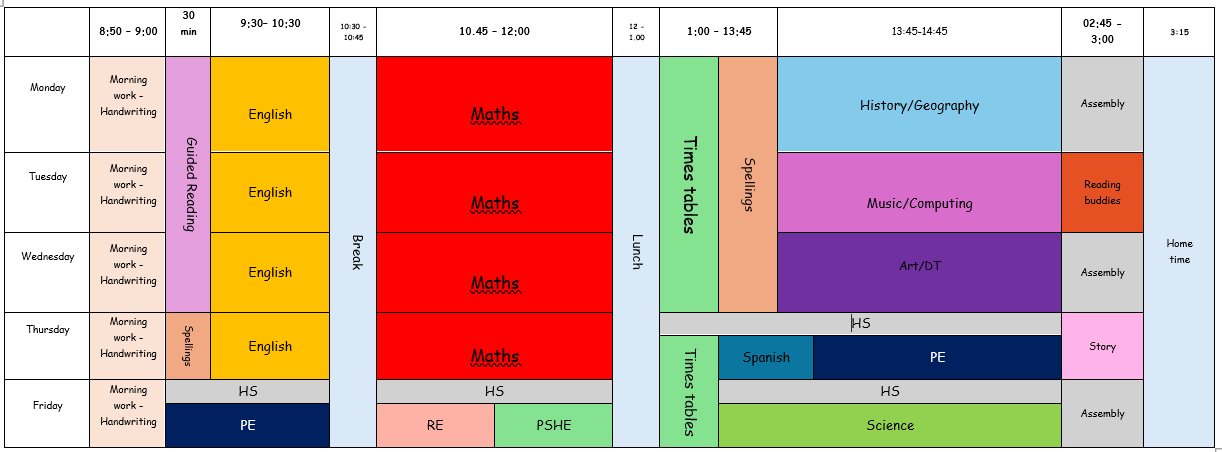
Class Peacock Timetable
Curriculum Overview
Useful Links
Statutory Assessments
Year 4 – Multiplication Tables Check
In Year 4, pupils take part in the Multiplication Tables Check (MTC). The check is designed to assess how fluently children can recall multiplication facts up to 12 × 12.
The check takes place during the summer term and is completed digitally. Children are asked a series of multiplication questions and have a short amount of time to answer each one.
Throughout Years 3 and 4, pupils regularly practise their times tables as part of their mathematics learning, helping them to develop the fluency and confidence they need to recall multiplication facts quickly and accurately.
The MTC is only one part of a child's mathematical development. Our focus is on building secure understanding and fluency through regular practice, reasoning and problem-solving, rather than preparing children specifically for a test.


