Class Kenny (Years 5&6)
Welcome to Class Kenny!
Welcome to Class Kenny!
Class Kenny is named after Olympic champion Laura Kenny, whose determination, teamwork and commitment have inspired people around the world. In our class, we aim to show these same qualities by working hard, supporting one another and always striving to achieve our best. We celebrate curiosity, creativity and resilience, and believe that every challenge is an opportunity to learn and grow. Our learning journey is full of exciting experiences, achievements and discoveries, and we look forward to sharing them with you. Please visit our page regularly to see what we've been learning and celebrating together.
Staff
Class Teacher: Mr Boxall-Goynes & Mrs Thomas
Teaching Assistant: Mrs Begum and Miss Nikki
Class Routines
Reading books: Brought in daily, changed weekly. (See your change-over day in your reading record)
Homework: Set on Tuesday – handed in on the following Tuesday.
Spellings: Set on Tuesday – tested the following Monday
PE: Friday
Swimming (wear PE kit): Thursday (Spring Term)
Celebration Assembly: Friday
Homework
Homework in Class Kenny is designed to be manageable, meaningful and to make a real difference to children’s learning. Educational research shows that practising reading, spelling and times tables little and often at home has a significant impact on children’s attainment and progress. Just 10–15 minutes a day makes a big difference! While we don’t want homework to feel like a burden, the tasks we set are vitally important in helping pupils build confidence and fluency.
-
Spellings are set every Tuesday and tested the following Monday. These are drawn from the National Curriculum word lists for Years 4, 5 and 6, or from pupils’ current phonics phase.
-
Reading is an ongoing expectation. We ask that children read at home every day, recording this in their reading records, which are checked weekly.
-
Times tables activities are set weekly, and children should also continue to use Times Tables Rock Stars at home to develop speed and fluency.
-
All pupils are given one additional piece of English (usually SPAG) homework each week, linked to their current learning, to help prepare them for the home learning routines of secondary school.
By supporting children with these regular short tasks, families help reinforce the learning we do in school and ensure every child keeps moving forward with confidence.
Reading with your child advice booklet (Year 5)
Curriculum Coverage
This Year's Topics (Cycle 1)
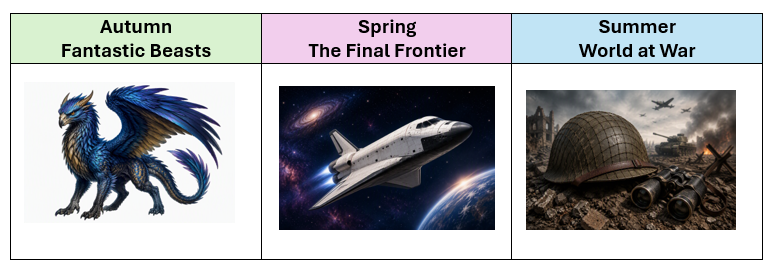
Fantastic Beasts Curriculum Coverage:
Mathematics
During the Autumn Term, children in Years 5 and 6 will develop their understanding of number and place value while building confidence with addition, subtraction, multiplication and division. They will learn to work with fractions, decimals and percentages, including calculating with decimal fractions and solving real-life problems involving money. Children will also explore measurement, area and scaling, applying their mathematical knowledge through reasoning and problem-solving activities to deepen their understanding and explain their thinking.
English
This term, our English learning begins with a non-chronological report unit focused on mythical creatures. Pupils will explore a range of legendary beasts from myths and folklore, learning how to organise information clearly using headings, subheadings, technical vocabulary and factual language. Children will research the appearance, habitat, powers and behaviour of these fascinating creatures before creating their own detailed reports for an informative audience.
We will then move on to writing a suspense narrative inspired by myths and legends. Pupils will study how authors build mystery, anticipation and excitement, exploring a range of legendary tales and mythical settings. Through this unit, children will learn how to create atmosphere and tension, select vocabulary for effect and use dialogue to reveal character and move the action forward. They will use these skills to craft their own engaging stories filled with adventure, danger and intrigue.
Later in the term, pupils will explore performance poetry inspired by The Jabberwocky by Lewis Carroll. Children will investigate the poem's imaginative language, nonsense words and vivid imagery before creating and performing their own poems based on mythical creatures and fantastical worlds. They will experiment with rhythm, expression and vocabulary to entertain an audience and bring their writing to life.
Throughout the term, pupils will continue to develop a range of important writing skills. They will learn how to write for different audiences and purposes, use cohesive devices and formal language features where appropriate, and improve their writing through careful editing, proofreading and publishing. These skills will help children become increasingly confident, independent and effective writers across a variety of genres.
Alongside their English writing, this term pupils will develop their understanding of grammar and punctuation through the Year 5 and 6 curriculum. Children will explore a range of word classes, determiners, clauses and conjunctions, learning how these features work together to create clear and effective sentences. They will learn to use expanded noun phrases, relative clauses and relative pronouns to add detail and interest to their writing, while also focusing on using commas accurately for clarity. Pupils will develop their understanding of Standard English and learn to recognise the vocabulary and grammatical structures appropriate for both formal and informal situations. Throughout the term, children will use and apply this grammatical knowledge to improve their speaking and writing, helping them communicate their ideas with greater accuracy, confidence and sophistication.
Throughout the term, pupils will develop their reading skills through the VIPERS approach: Vocabulary, Inference, Prediction, Explanation, Retrieval and Summarising. Children will read and discuss a wide range of fiction, non-fiction and poetry texts, building their understanding of how authors use language, structure and presentation to create meaning. They will learn to identify and explain ambitious vocabulary, make inferences using evidence from the text, predict events based on clues and justify their opinions with reasons. Pupils will also practise retrieving and recording information, summarising key ideas from across a text and participating in thoughtful discussions that build on their own and others' ideas. Alongside this, children will continue to develop their reading fluency and prosody, reading aloud with increasing confidence, expression and understanding while fostering a lifelong enjoyment of reading.
Science
In Autumn 1, pupils will study Living Things and Their Habitats, developing their understanding of how scientists organise and classify the natural world. Children will learn how living things can be grouped according to their characteristics and will explore the differences between a wide range of animals, plants and micro-organisms. They will investigate how classification systems help scientists identify and compare living things, including the work of Carl Linnaeus, whose system is still used today. Pupils will develop their scientific knowledge by sorting organisms into groups, recognising similarities and differences, and understanding the importance of accurate classification. Throughout the unit, children will apply observation, comparison and research skills to deepen their understanding of the diversity of life on Earth.
In Autumn 2, pupils will study Forces, exploring how different forces affect the movement of objects in everyday life. They will investigate the effects of gravity, learning how it acts on objects and keeps us grounded on Earth. Children will explore friction, air resistance and water resistance, discovering how these forces can slow down or influence movement. Through a range of practical investigations, pupils will plan and carry out fair tests, record and analyse results, and use scientific evidence to explain their findings. They will also examine how simple mechanisms, such as levers and pulleys, can allow smaller forces to have greater effects. Throughout the term, children will continue to develop key scientific enquiry skills, including predicting, observing, measuring, recording results and drawing conclusions from evidence.
History
This term, pupils will study Ancient Greece, exploring one of the most influential civilisations in world history and examining how its achievements continue to shape life in the modern world. Children will learn about the geography of Ancient Greece and investigate how city-states such as Athens and Sparta developed, comparing their different ways of life, systems of government and values.
Pupils will explore key aspects of Greek civilisation, including democracy, education, religion, the Olympic Games, art, architecture and philosophy. They will investigate the achievements of the Ancient Greeks and consider how many of their ideas and innovations have influenced the Western world, including modern government, sport, language and learning.
Throughout the unit, children will develop their understanding of chronology by placing Ancient Greece within a wider historical timeline and making connections with other periods of history they have studied. They will identify similarities, differences, continuities and changes over time, using appropriate historical vocabulary to discuss events, people and achievements.
Children will also gain a broader historical perspective by exploring how cultural, political, social, religious and economic factors shaped Ancient Greek society. They will examine the connections between local, national and international history and consider both the short-term and long-term impact of Greek achievements on later civilisations. Through the use of artefacts, historical sources and enquiry-based learning, pupils will develop their skills as young historians, asking questions, analysing evidence and evaluating different interpretations of the past.
Geography
This term, pupils will explore the topic of Biomes, developing their understanding of the diverse environments that exist across our planet and the factors that influence where different plants and animals can live. Children will begin by learning what biomes are and investigating the characteristics of major global biomes, including tropical rainforests, deserts, grasslands, tundra and temperate forests. They will explore how climate, temperature and rainfall affect the vegetation and wildlife found within each biome.
Pupils will then study vegetation belts, learning how different types of plant life are distributed across the world and how plants adapt to the conditions of their environment. They will examine the relationship between climate and vegetation and investigate why certain plants thrive in some regions but not in others.
As the unit develops, children will use a variety of maps, atlases and digital resources to locate countries and regions around the world. They will investigate the physical and human characteristics of different countries, exploring how landscapes, climate and natural resources influence the ways people live and work.
Pupils will also study major cities and environmental regions across these continents, comparing similarities and differences between locations and examining how geography affects both human activity and the natural world. Through map work and geographical enquiry, they will develop their understanding of global connections and gain a greater appreciation of the diversity of places around the world.
Throughout the unit, children will strengthen important geographical skills, including interpreting maps, analysing data, asking geographical questions and drawing conclusions from evidence. They will also consider how people interact with their environment and reflect on the importance of protecting the world's natural habitats and ecosystems for future generations.
Art
This term in Art, pupils will explore Ancient Greek Pottery, developing their understanding of how art can provide valuable insights into life in the ancient world. Children will begin by investigating examples of Greek pottery, examining the shapes, patterns and decorative techniques used by Ancient Greek artists. They will explore how pottery was used in everyday life and how painted scenes on pots can help historians learn about Greek culture, beliefs and traditions.
Pupils will study the work of ancient craftsmen and designers, identifying the distinctive features of Greek pottery, including geometric patterns, decorative borders and figure painting. Using sketchbooks, children will record their observations, experiment with ideas and refine their designs, revisiting and improving their work throughout the topic.
As the unit develops, pupils will explore a range of artistic techniques, including drawing, sculpture and clay work. They will practise creating Greek-inspired patterns and decorations, using different materials to develop their artistic skills and understanding of composition. Children will learn how repetition, symmetry and symbolism were used in Ancient Greek art and will apply these features within their own designs.
A particular focus will be placed on sculpture and clay techniques, with pupils learning how to shape, mould and decorate clay to create their own pottery-inspired pieces. They will experiment with texture, form and detail before designing and producing a final piece influenced by the styles and motifs of Ancient Greece.
Throughout the unit, children will develop their mastery of artistic techniques while learning about significant artists, designers and craftspeople from history. By evaluating both historical artefacts and their own creations, pupils will gain a deeper appreciation of Ancient Greek art and its lasting influence on art, design and culture today.
Design & Technology
This term in DT, pupils will explore Electrical Systems and Product Design, developing their understanding of how electrical components can be used to create functional and appealing products. Children will begin by investigating a range of existing products that use electrical systems, such as lamps, alarms and interactive toys. They will analyse how these products have been designed, considering their purpose, target audience and the features that make them effective.
Pupils will then carry out research to help them develop their own design ideas. They will identify a user or purpose for their product and create design criteria to ensure their final outcome is both practical and attractive. Through discussion, sketching and planning, children will learn how designers develop and refine ideas before beginning production.
As the unit develops, pupils will focus on electrical systems and circuit design, learning how series circuits work and exploring the role of components such as switches, bulbs, buzzers and motors. They will investigate how electrical circuits can be used to enhance products and will apply this knowledge when designing and constructing their own creations.
Children will have opportunities to build, test and modify circuits, developing their problem-solving skills and resilience when faced with design challenges. They will learn the importance of testing throughout the design process, making improvements and adjustments to ensure their products function as intended.
Throughout the project, pupils will evaluate their work against their original design criteria and consider feedback from others to refine and improve their designs. By the end of the unit, children will have designed and created an innovative electrical product, combining creativity, technical knowledge and practical skills while gaining a deeper understanding of how design and technology can solve real-world problems.
Computing
This term in Computing, pupils will explore Databases and Data Handling, developing their understanding of how information can be collected, organised and analysed using digital tools. Children will begin by learning how information can be recorded and stored, using forms and data cards to create their own simple databases. They will investigate different ways of organising information by ordering, sorting and grouping data to make it easier to find and use.
Pupils will then compare paper-based and computer-based databases, learning about important database features such as fields and records. They will explore how computer databases allow information to be viewed in different ways and will practise sorting data using different fields to answer specific questions.
As the unit develops, children will learn how databases can be used to group and sort information efficiently. They will investigate how selecting and organising data can help users identify patterns, draw conclusions and answer increasingly complex questions. Pupils will also explore how search tools can be used to locate specific information within a database, learning how multiple criteria can be applied to refine results.
Children will be introduced to the use of ‘AND’ and ‘OR’ conditions, discovering how these functions allow searches to become more precise and effective. They will apply these skills to solve problems, investigate data sets and answer questions using a range of database tools.
Pupils will also learn how to present information visually by creating and interpreting charts and graphs. They will consider which types of charts are most effective for different kinds of data and will use filters to compare information and identify trends. Through this work, children will develop an understanding of the advantages of using computers to organise, analyse and present large quantities of information.
Finally, pupils will apply their learning using real-world databases, asking their own questions, carrying out refined searches and analysing the results they find. They will present their findings to others, explaining how they gathered evidence and reached their conclusions. Throughout the unit, children will develop important computational thinking skills, including logical reasoning, data analysis, problem-solving and effective communication, while gaining a deeper understanding of how databases are used in everyday life.
PSHE
This term in PSHE, pupils will take part in the Me and My Relationships unit, helping them to develop positive relationships and a greater understanding of themselves and others. Children will explore the qualities of healthy friendships, learning about trust, respect, kindness and effective communication. They will discuss how to work cooperatively with others, manage disagreements appropriately and recognise the importance of empathy and understanding in building positive relationships.
Pupils will also develop their emotional literacy, learning strategies to identify, express and manage a range of emotions. They will explore ways to resolve conflicts peacefully, consider how their actions affect others and build resilience when faced with challenges. Through discussion, role-play and reflection, children will develop confidence, self-awareness and the skills needed to maintain healthy and respectful relationships both in school and beyond.
Physical Education
This term in PE, pupils will develop their Fundamental Movement Skills through a focus on Travelling and Jumping. Children will practise moving confidently and efficiently in a variety of ways, including running, hopping, skipping, galloping and changing direction with control. They will develop their jumping skills by exploring different types of jumps, such as vertical, horizontal and combination jumps, while improving balance, coordination and body control. Through a range of individual activities, partner work and team challenges, pupils will learn how to move safely and effectively, building agility, strength and spatial awareness. Throughout the unit, children will be encouraged to challenge themselves, demonstrate perseverance and develop confidence in their physical abilities while enjoying an active and healthy lifestyle
Music
This term in Music, pupils will explore Singing the Blues, developing their musical understanding through singing, performing, composing and improvising. Children will begin by learning about the characteristics of blues music and exploring how musicians use melody, rhythm and expression to communicate mood and emotion. They will develop their improvisation skills by creating their own musical phrases over a drone using tuned percussion and other melodic instruments.
Pupils will also learn how to compose and perform their own music, creating simple melodies and exploring how chords can be used to create different atmospheres and moods. They will experiment with combining melodies and accompaniments, developing confidence in making creative musical choices and refining their compositions. Pupils will also develop their ability to play by ear, listening carefully and reproducing melodies and musical phrases.
Throughout the unit, pupils will improve their understanding of musical notation, learning to recognise different note values, rests and time signatures. They will practise reading and performing rhythms and pitches accurately, building fluency and confidence as musicians.
Singing remains at the heart of the topic, with children performing a wide variety of songs while focusing on accurate pitch, clear phrasing and expressive performance. They will sing rounds, partner songs and songs with verses and choruses, working together to perform as part of an ensemble. Throughout the term, pupils will have opportunities to share their musical learning through class performances, assemblies and other school events, developing confidence, creativity and enjoyment in music-making.
Spanish
This term in Spanish, pupils will begin by developing their confidence in introducing themselves and holding simple conversations. Children will learn key vocabulary and phrases to greet others, say their name, describe themselves and share basic personal information such as their age and interests. Through speaking, listening, reading and writing activities, they will practise forming simple sentences and responding to questions in Spanish.
As the unit develops, pupils will expand their language skills by learning descriptive vocabulary to talk about their appearance and personality. They will build their pronunciation and conversational confidence through games, songs, role-play and partner activities, while also developing their understanding of Spanish grammar and sentence structure. Throughout the unit, children will be encouraged to communicate in Spanish as much as possible, helping them become increasingly confident and enthusiastic language learners.
RE
This term in Religious Education, pupils will explore Sikh Worship and Community, developing their understanding of Sikh beliefs, values and ways of life. Children will learn about the importance of the Gurdwara as a place of worship and community, discovering how Sikhs come together to pray, learn and support one another. They will explore key features of Sikh worship, including the Guru Granth Sahib, prayer, music and the significance of serving others through seva (selfless service).
As the unit develops, pupils will investigate how the Sikh community puts its beliefs into practice through acts of kindness, equality and respect. They will learn about the Langar, the community kitchen found in every Gurdwara, and explore how it reflects Sikh values of inclusion and sharing. Through discussion, reflection and enquiry, children will develop their understanding of how faith can influence people's lives and communities, while encouraging respect for different beliefs and traditions in modern Britain.
Class Timetable
Curriculum Overview
Academic Expectations
Statutory Assessments
In Key Stage 2, children take part in a small number of national assessments. These are designed to check progress against the National Curriculum and to give a clear picture of how children are doing. We always approach these in a calm and supportive way, making sure pupils feel confident and prepared without any unnecessary pressure.
Year 6 – SATs (Standard Assessment Tests)
-
Taken in May over the course of one week.
-
Pupils sit several short papers under formal test conditions, but we make sure the week feels calm and supportive.
-
Reading Test (1 paper, 1 hour): Pupils read a booklet of texts (fiction, non-fiction and poetry) and answer questions to show their understanding, inference and ability to retrieve information.
-
Grammar, Punctuation and Spelling (SPaG): This has two parts — a grammar and punctuation paper (45 minutes of short questions) and a spelling test (around 20 words read aloud).
-
Mathematics: Pupils complete three papers — one arithmetic paper (30 minutes) which tests calculation skills, and two reasoning papers (40 minutes each) which test problem-solving and application of maths in different contexts.
-
-
Writing is not tested by a paper. Instead, it is teacher assessed across the year, using a wide range of independent work from different writing genres.
-
The results provide a national benchmark and are shared with secondary schools to help ensure a smooth transition.
How parents can help at home
The best way families can support is through regular reading, encouraging children to practise their times tables, and talking positively about learning. Little and often makes the biggest difference. A calm routine, plenty of encouragement and celebrating small successes all help children to feel confident and ready for any assessment.
Useful links
Class Kenny Photos